
Trace Who Owns a Kansas Property
A solid Kansas owner lookup joins two records from two county offices. The Appraiser's card ties a tax-roll name to an address or parcel. The Register of Deeds index shows the parties to recorded transfers. Start with the land's physical county, never the mailing city. Carry the parcel key and legal description from the first result. Take both straight into the deed records search. This route shows who appears in the public property record. It also shows how to verify the newest filing. It will not identify an occupant or replace a title review.
- Use the situs address to choose the Kansas county that contains the parcel.
- Open that county's Appraiser search and look up the address; if it fails, try a known parcel key, owner name or legal description.
- Copy the owner label, parcel number, legal description and the separate mailing and situs fields.
- Search the county Register of Deeds by the current grantee or legal description, then inspect the newest transfer instrument.
- If an entity is named, use the Kansas Secretary of State business search for filing context and compare the exact name on the deed.
The official county list helps route that first step to the right county. A no-hit in one portal is not proof that nobody owns the parcel. Try the other documented search keys and ask the custodian about its index period.
Where Kansas Property Owner Records Come From
Kansas keeps no single statewide owner roll. Each source adds a different clue. Only the county land instrument documents a recorded conveyance. A GIS map popup may simply repeat tax-roll fields, while a business registry can explain an entity's name but never show which parcel it owns.
| Source | Owner Info It Gives | Access |
|---|---|---|
| County Appraiser roll | Owner or taxpayer name associated with the parcel, plus mailing and situs fields where shown | Use that county's property portal; access and update timing vary |
| County Register of Deeds | Grantor and grantee named in a recorded transfer, with document reference and legal description | County index, image or counter; cutoff and fee vary |
| County GIS service | Parcel key and, in some layers, owner1 or owner2 display fields | County map or GIS service; reference data only |
| Kansas Secretary of State | Business name, Kansas ID or resident-agent information for a filed entity | Free business search; it does not connect an entity to a parcel |
An owner-of-record field names the party attached to the assessment roll. It does not say who lives there. A mailing address can point to a bank, tax service, trustee, lawyer, or PO box. The situs is simply the land's physical location. The Sedgwick County records crosswalk shows the separate roles of the Appraiser, Register of Deeds, County Clerk, and Treasurer.
- Owner of record
- The name shown in a county's tax-roll property file.
- Grantee
- A party receiving an interest in a recorded instrument.
- Situs
- The physical location of the land or building.
- Mailing address
- Where the tax notice is sent; it need not be the situs or an occupant's residence.
The county's overview traces where owner and tax information lives. Open the Sedgwick County ownership and sales reference before viewing the example image.
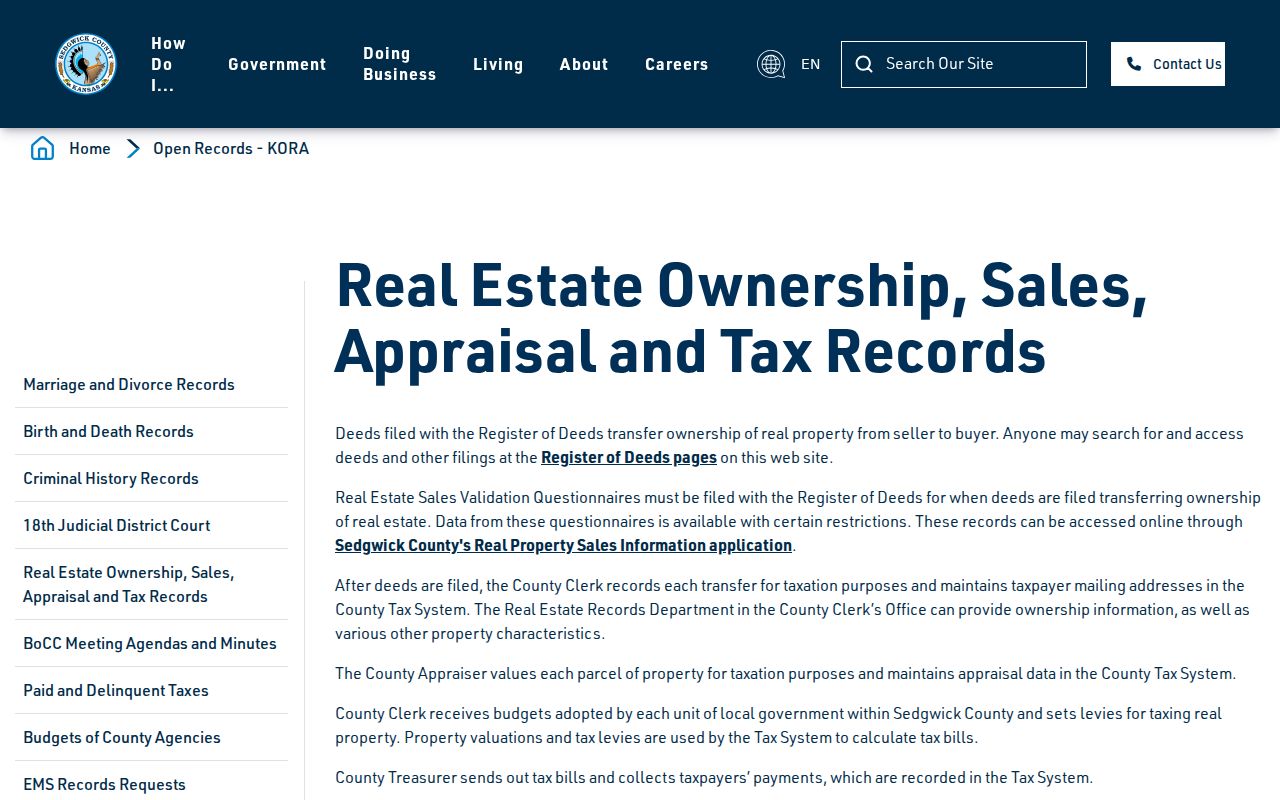
The crosswalk clarifies office roles well. Still, a parcel-specific question needs the right county's current property records.
Route a Kansas Property by Its Situs
The situs is the property's physical location. It is the best clue for choosing a county. A city printed in a mailing address can cross a county line or name an unincorporated delivery area. So it never settles the question alone. Kansas ZIP codes follow USPS delivery geography rather than municipal boundaries. Use the county list for the land's jurisdiction. Then compare the county GIS or Appraiser situs field when the location is unclear.
For mail geography, the USPS ZIP Code Lookup can check an address. That result normalizes a mailing address. But the county parcel map and legal description still control the property route. Keep the mailing address and the situs separate while moving between systems.
A rural route or an older street number may not match a current portal label. Try a known parcel number, plat name, or legal description instead. Ask the county Appraiser which key identifies the card.
Carry the Kansas Parcel Key Into the Deed Index
Once an assessor result appears, copy the county's parcel identifier and legal description. Do this before leaving the card. Kansas has no single statewide parcel-number format. One portal may call its key PIN. Another uses RE Tax ID or Quick Ref ID. The recorder may index by party names or legal description rather than by that number. The description often bridges best to the land instrument. It may be subdivision, lot and block, or section-township-range.
The Douglas County advanced search is one concrete owner route. Its form includes Owner Name, Business Name, and Owner ID. Parcel and subdivision fields sit alongside them. Those fields do not mean every county accepts name searches or shares the same syntax. If the assessor result returns several names, narrow by situs, legal description, and parcel key. Only then treat a match as the true owner of record.
The broader Kansas property search walkthrough covers search inputs and result fields. This owner route uses only the key that moves a name from the county roll. That key is what links the roll into the deed index.
Compare the Kansas Tax Roll With the Newest Deed
A county's owner label is useful, but it is a snapshot of the assessment roll. Kansas Appraisers value real property each year as of January 1, and county portals update on local schedules. Douglas County says its online appraised values update in November after the current tax year is calculated; there is no verified statewide average for how soon a deed changes the owner field.
If the owner name looks stale, search the county Register of Deeds for the newest recorded transfer using the grantee or legal description. Compare the grantor, grantee, recording date, instrument type and legal description. A recorded deed can be newer than the online tax card, while an assessor change-of-address entry updates tax mailing rather than ownership. The current owner record guide explains what to check on the present-day roll.
Note: Ask the local Appraiser when it processes recorded transfers if the portal's update date is not displayed.
Match Kansas Trust, LLC and Estate Names Carefully
Entities rarely hide ownership on purpose. An LLC, trust or estate simply appears on the assessment card or deed. The formal style differs from a person's name. Search the full entity name first. Then try common punctuation and suffix variants where the portal allows. The Kansas Secretary of State business search supports lookup by business name, Kansas ID or current resident agent. It caps results at 200. That filing record clarifies an entity's registered-agent context. It does not establish parcel ownership. The recorded deed still connects the entity to the land.
Trust names may be shortened or indexed with the trustee listed first. An estate transfer can appear under the estate name, the executor or the administrator. A probate order may explain the authority behind a recorded deed. Treat each name as a separate clue. Do not assume two similar entries name the same party.
An entity missing from SOS results is not necessarily absent from ownership. A sole proprietorship, trade name or out-of-state entity may not appear there in the same way. Anchor your search to the deed's grantee and the legal description. The parcel stays at the center of the work.
A Kansas Owner Alert Is a Lead, Not Proof
A name-match alert is a lead, never proof. Some counties offer monitoring for newly recorded instruments. Sedgwick County's free Property Fraud Alert reports a document number, type, date and matched party. Reno County's Fraud Notify is described as an early warning that does not prevent fraud. Enrollment is county-specific. When a match arrives, read the filing itself. Contact the Register of Deeds if it looks unfamiliar. A match alone shows neither an ownership change nor an unlawful document.
Privacy rules also shape what an owner lookup can display. Kansas Open Records Act exceptions and other statutes can protect selected personal information. KORA lists of names and addresses may require a certification against prohibited commercial use. The Attorney General's Safe at Home program supplies a substitute address to qualifying participants for certain government records. The Kansas Attorney General's KORA FAQ explains public-request limits. A previously recorded deed is not automatically removed from the land record.
Note: An alert service monitors only the participating county's recording system and is not title insurance.
What a Kansas Owner Search Cannot Prove
Some counties offer name-match monitoring on newly recorded instruments. Sedgwick County's free Property Fraud Alert reports a document number, type, date and matched party. Reno County's Fraud Notify is described as an early warning that does not prevent fraud. Enrollment is county-specific. A match means one thing: read the filing. Contact the Register of Deeds if it looks unfamiliar. The alert alone shows neither an ownership change nor an unlawful document.
Privacy rules also shape what an owner lookup reveals. Kansas Open Records Act exceptions and other statutes can shield selected personal information. KORA lists of names and addresses may require certification against prohibited commercial use. The Attorney General's Safe at Home program gives qualifying participants a substitute address. It applies to certain government records. The Kansas Attorney General's KORA FAQ covers the limits of public requests. A deed already recorded is not removed from the land record for privacy reasons.
Note: An alert service watches only the participating county's recording system and is never title insurance.
Lawful use. Use Kansas owner records for property research and due diligence. Do not use a name or address to stalk, threaten, intimidate or harass a person.