
Tracing Kansas Former Property Owners
Every parcel in Kansas carries a paper trail of hands it has passed through. Kansas property records let you follow that trail. Work from the newest owner of record back through the grantor-grantee index one instrument at a time. A street address can open the search, but the legal description is the better key. Roads get renamed. Older deeds may use lot and block or a rural section instead. No single statewide online cutoff exists. A county portal may drop you into deed books, microfilm, or an archive. You can search Kansas property records by county through each Register of Deeds. Every link in the chain should rest on an actual instrument. Never assume a name match.
| Transfer Date | Grantor → Grantee | Deed Type | Book/Page |
|---|---|---|---|
| Date on latest recorded instrument | Prior grantor → grantee named for the parcel | Label shown in the county index | Document number or book/page from that record |
| Date on preceding instrument | Earlier grantor → prior grantee | As indexed or printed on the deed | Earlier document number or volume/page |
| Date in older deed book | Continue the same role-by-role link | Entry type from the book or index | Volume and page used to retrieve it |
Put the county name and parcel description on every note you keep. Sequence beats address in a historical chain. Streets get renamed, rural numbers change, and tracts are replatted, so the deed's order of transfer is the thread that holds.
How Far Kansas Ownership Records Reach
Kansas has no common online starting point for ownership records. Each county Register of Deeds picks its own vendor, scanned books, and name index. It also decides remote image access. Ness County is one example. Its Register of Deeds search instructions report documents back to 1988, with index images scanned through 2023. The office points users to the legal description and "Find Now" for newer records. Treat those details as Ness County instructions alone. Sedgwick County runs differently. Its Register of Deeds describes Tapestry EON as an upgraded land-records system that launched in February 2025. It allows remote searches by grantor or grantee, date range, and legal description. The office suggests searching one criterion at a time, and remote access carries county-specific prices. Neither county sets a statewide depth for Kansas property records. The Sedgwick County Tapestry EON information page names the county's current land-records service. It also carries the launch note.
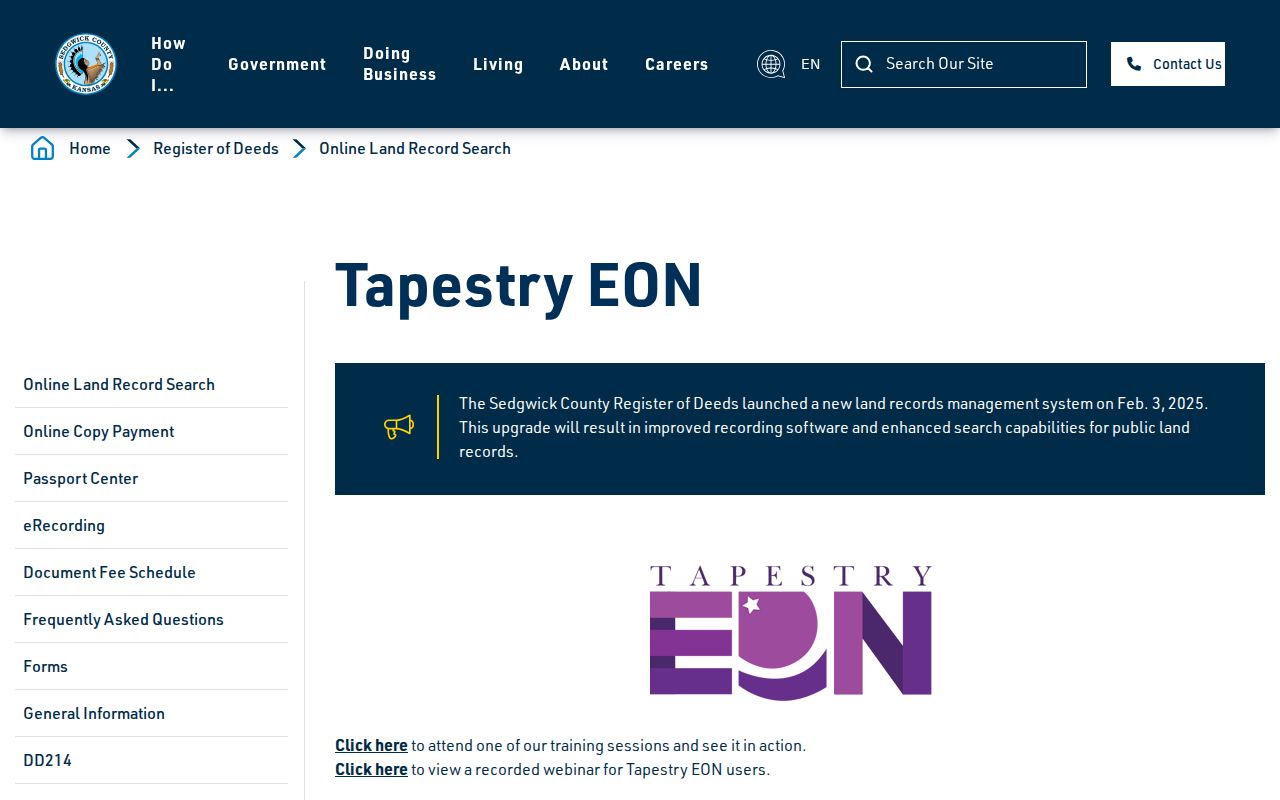
That was one county portal in action. Check the matching Kansas county's own search page for its dates, fees, and route to older records.
Use the cutoff as a handoff. If an online index stops, ask the county for older deed books and grantor/grantee indexes, then check the Kansas Historical Society catalog or local library for filmed records.
Read a Kansas Deed Chain Backward
Grantor means the party conveying an interest. Grantee means the party receiving it. The chain of title is the ordered set of recorded instruments. It traces a property's successive transfers. Kansas county indexes may list names in different order. A party can be a person, trust, estate, or company. Follow the legal description across every entry instead of trusting a shared surname. Each former owner must anchor to a specific grantee entry. Then the parcel search steps back another generation.
- Start with the newest deed that matches the parcel's legal description.
- Write down its recording date, document number or book/page, instrument type, grantee, and grantor.
- Search the grantor as a grantee in the prior period, then compare the description on the earlier deed.
- Repeat until the county's online range ends; continue with its books, microfilm, or archive finding aid.
- Grantor
- The deed party listed as conveying the interest.
- Grantee
- The party named as receiving the interest.
- Reverse index
- A way to follow a prior grantor backward as the earlier grantee.
- Legal description
- The parcel description used to check that successive records concern the same land.
This method targets past transfers, not the mechanics of a single current lookup. The Kansas deed records page covers deed-index fields and record types in detail. Current tax-roll names belong to a separate present-owner check.
Kansas Index Warnings Matter
Ness County cautions that its online indexes can omit a document or misspell a name. Its older book series carry several prefixes, including D, MS, PT, OG, OGR, and RA. Books 55 and later may drop the prefix entirely. Those labels belong to that county alone. The broader lesson for a Kansas property search is simple. A zero result is not proof that no deed exists. Try the legal description, an alternate spelling, or a direct call instead. The Ness County Register of Deeds page shows the county's own search route. It is a good example of an office that publishes clear search instructions. They cover both online tools and the older book records.
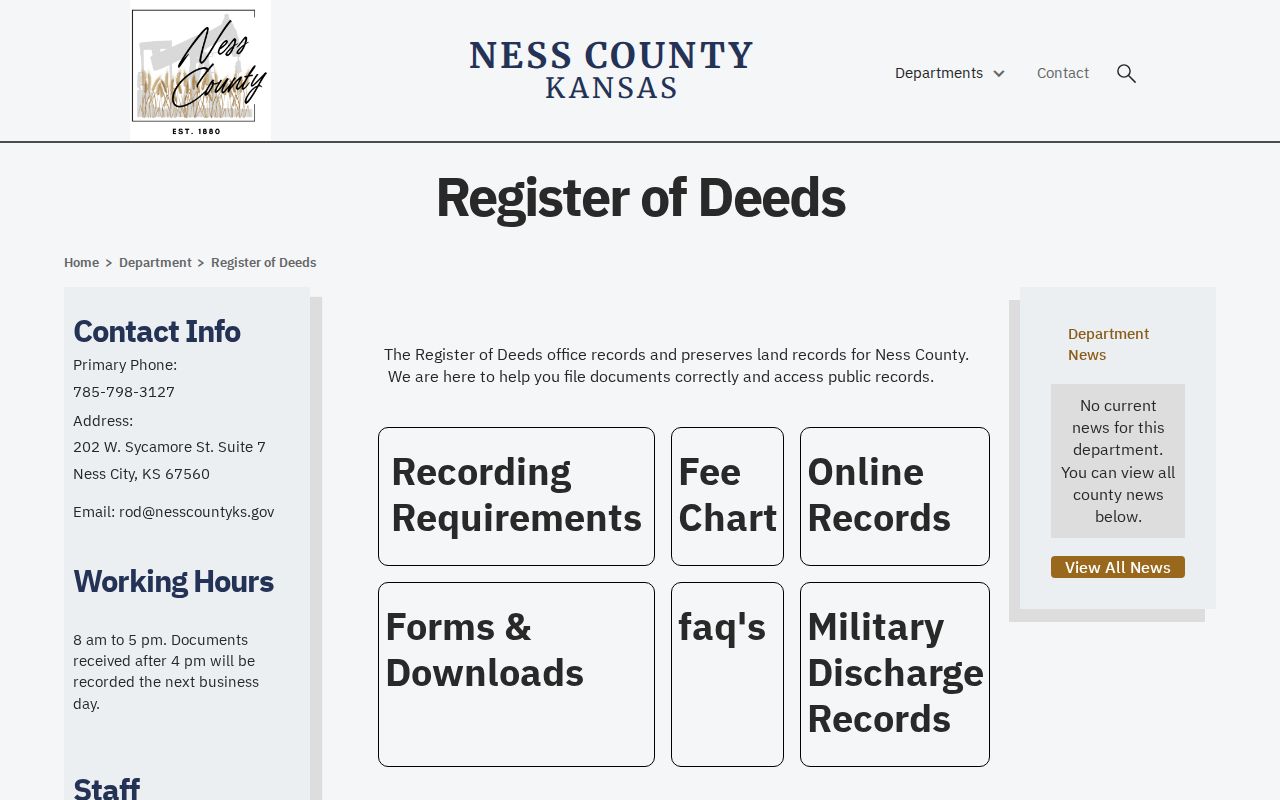
Because that page is county-specific, its book codes, contact details, and cutoff stay there. Copying them into another Kansas county's deed search would only mislead.
Older Kansas Deed Books and Archives
The county Register of Deeds stays the primary custodian of its original deed books. It also holds indexes, plats, and later microfilm. For transferred or filmed records, the Kansas Historical Society State Archives holds selected county material. Its Crawford County deed series shows what that can look like. The run covers deeds from 1867 through 1935 on 26 microfilm rolls, recording instrument nature, indenture date, grantor, grantee, property description, consideration, and filing date. Entries are chronological and indexed separately by grantee, grantor, or number. One county's run proves nothing about the next. The Kansas Historical Society finding aid for the Crawford County deed series identifies the series. Its content fields are listed there as well.
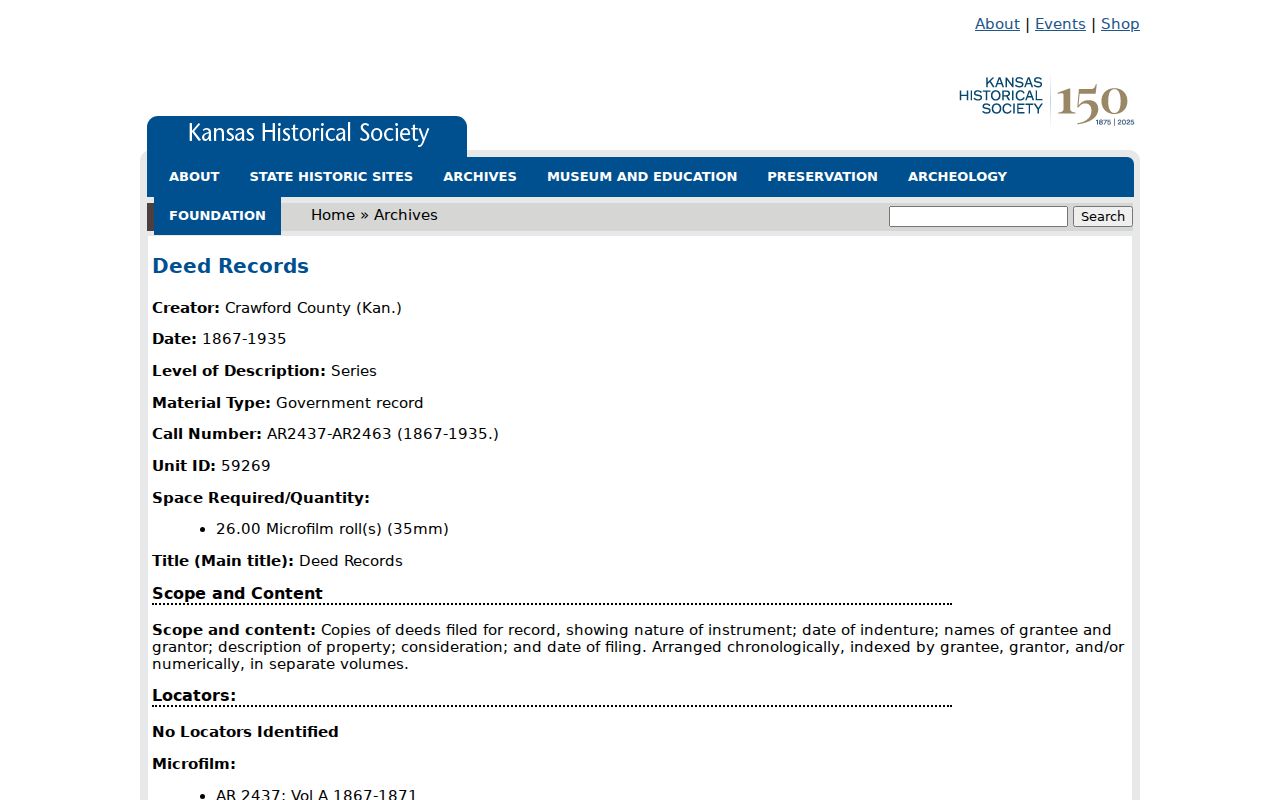
A finding aid like that shows how an older chain can be organized. It does so outside any modern search box. Ask at the county counter about its own book and index arrangement first. Then turn to the State Archives catalog, research room, or interlibrary loan if a filmed series covers that county. Older plats and deed records often surface this way.
Kansas Probate and Court Transfers
Estate transfers rarely look like ordinary sales. A personal-representative deed can pass a Kansas parcel. So can a probate order, transfer-on-death deed, survivorship affidavit, or trustee conveyance. None of these is a warranty deed between buyer and seller. The tax roll may still show the old name while a fiduciary finishes the paperwork. The recorded land instrument remains the public parcel trail. A district-court probate case may hold the orders or appointments behind it. That is why a former owner of record sometimes appears through a court-supported conveyance rather than a direct sale.
An estate or property case might explain a transfer. In that situation, search Kansas Courts CaseSearch by the person's name and county. What you can view depends on the local eCourt conversion date. Older public material may sit at a courthouse kiosk or need a written clerk request. A sheriff's deed, tax foreclosure, lis pendens, or lien judgment can also break a clean deed sequence. Note the instrument type, date, party roles, and legal description. Then follow the chain to the next transfer.
Kansas Plats and Old Addresses
A street address is a modern locator, not a stable deed key. Legal descriptions endure. Lot-and-block descriptions, subdivision names, section-township-range calls, and metes-and-bounds courses survive address changes. So search the Register of Deeds by description instead of house number. Recorded plats, replats, lot splits, vacations, and dedications matter when a parcel's shape or label changed. A former owner may sit under an older lot description. The street number no longer matches.
The Kansas Historical Society map collections hold land-survey records, county atlases, and plat books. These cover the 1880s through the 1920s. Some atlases name rural landowners, section lines, farms, roads, schools, churches, cemeteries, and resident directories. They enrich property history and neighboring-owner clues. They are not, however, a current ownership record or a deed substitute. The KSHS map collections describe the archive holdings.
Kansas Digitization Moves in Stages
Digitization of Kansas land records moves county by county. Sedgwick County's 2025 system change and its older book indexes show that "online" can mean a live search form. It can also mean a scanned historical index, or a paid image layer. Reno County's January 2026 report places 14 of 18 land-index books in the first digitization phase. That followed its records-management transition. That figure is a Reno County progress report, not a statewide image count.
The county's Fraud Notify announcement describes an early-warning name alert tied to its land-record system. An alert is not proof of fraud and not a chain-of-title tool. It simply points you toward a recorded document for review. The county's current notice plus the instrument itself still say what was actually recorded.
Kansas Former Owner Access Routes
Older deed research usually moves offline once the county's remote index runs out. Each county Register of Deeds holds grantor and grantee books, legal-description indexes, and public terminals covering earlier years. The counter staff can explain which copies exist for the period in question. Fees and search paths vary by county, with no uniform statewide rule. A focused Kansas Open Records Act request can identify an instrument by party, legal description, recording date, or book and page. Staff are not required to research an open-ended ownership chain, though. Offline sources like these often reach former owners who fall outside the online record dates.
Filmed and transferred collections open another route. The Kansas Historical Society Archives Catalog covers many of these holdings. Its reference staff can describe research room access and interlibrary loan options. County libraries and historical societies sometimes keep plat books, directories, newspapers, and local indexes that fill gaps in the deed record. When the ownership link matters, pair any secondary index with the recorded deed itself. The Kansas ROD directory lists office contacts. That helps route a question to the county where the land sits.
Kansas Former Owner Record Limits
Every Kansas chain of title ends where the evidence ends. An online index may omit a name. An older book may key parcels differently. A court order may support a transfer, or a historic plat may predate the current address. No single statewide date marks the first or last deed in every county. Kansas gained statehood in 1861. Yet land evidence can begin earlier through federal surveys, patents, territorial records, county organization, and local books.
Former-owner research serves property history, estate work, and due diligence. A matching name alone proves no identity, title, or current occupancy. Use public records lawfully. Never use owner details to track, threaten, or harass a living person. For today's tax-roll name, see the Kansas current property owner record; for older transfers, compare each original instrument rather than trusting an index summary.