
What Kansas Deed Records Show
Deed records in Kansas live at the county level. Knowing where a parcel sits matters before you hunt for a grantor or grantee. A recorded deed names the parties and the land conveyed. Mortgages, releases, easements, liens, and plats often sit in the same land-record index. When an address is not indexed, search Kansas deed records by owner name or legal description. Then use the recording reference to view or order the instrument. Counties differ on online access and image rules. Older books may call for help from a local records office or archive.
| Deed Type | What It Does | Common Use |
|---|---|---|
| Warranty deed | Conveys the grantor's stated interest with deed warranties. | Ordinary conveyance; read the actual terms. |
| Quitclaim deed | Transfers whatever interest the grantor has, if any. | Family transfers or title cleanup. |
| Trustee or executor deed | Shows a conveyance by a fiduciary acting for a trust or estate. | Trust administration or probate transfer. |
| Sheriff or tax deed | Records a transfer tied to a court or tax-sale process. | Review with the docket and later filings. |
| Correction deed | Amends a prior instrument's stated details. | Compare it with the deed it corrects. |
Other Kansas deed records cover transfer-on-death, trustee, personal-representative, mineral, and correction instruments. Entries nearby may be mortgages, releases, assignments, easements, restrictive covenants, or liens. Those are different record types. A mortgage or lien can affect an interest in land, yet it conveys no ownership the way a deed does. A full title review can also pull in plats, dedications, vacations, replats, oil-and-gas leases, tax liens, or UCC fixture filings. These often share the same county index with deed records. Their meaning depends on the instrument itself and any later release or court order, so treat the document type as a filter rather than a substitute for reading the recorded image.
Kansas Deed Records in Sedgwick's Tapestry
Sedgwick County shows how one office runs deed records online. It is not a statewide portal. Its Register of Deeds put Tapestry EON live on February 3, 2025. Searches can run on grantor, grantee, date range, or legal description. The county suggests starting with a single criterion such as a last name or a subdivision. One caution stands out: parcel-number searching is not recommended in this system.
Fees on the Sedgwick page include an $8.75 index or image search. Printing runs $1 per page. Those are Sedgwick prices alone. Payment works pay-as-you-go by card or through an open account with a $25 monthly minimum. Read the county page before starting any remote search.
Index access and image access are separate steps. A result can name the document before you pay to open or print the image. Paying for a search does not make every page free to view. Sedgwick's browser system works remotely. Other county offices may instead offer a free index, paid images, or a public terminal.
The Sedgwick County Tapestry EON search page posts the county's fields and current terms.
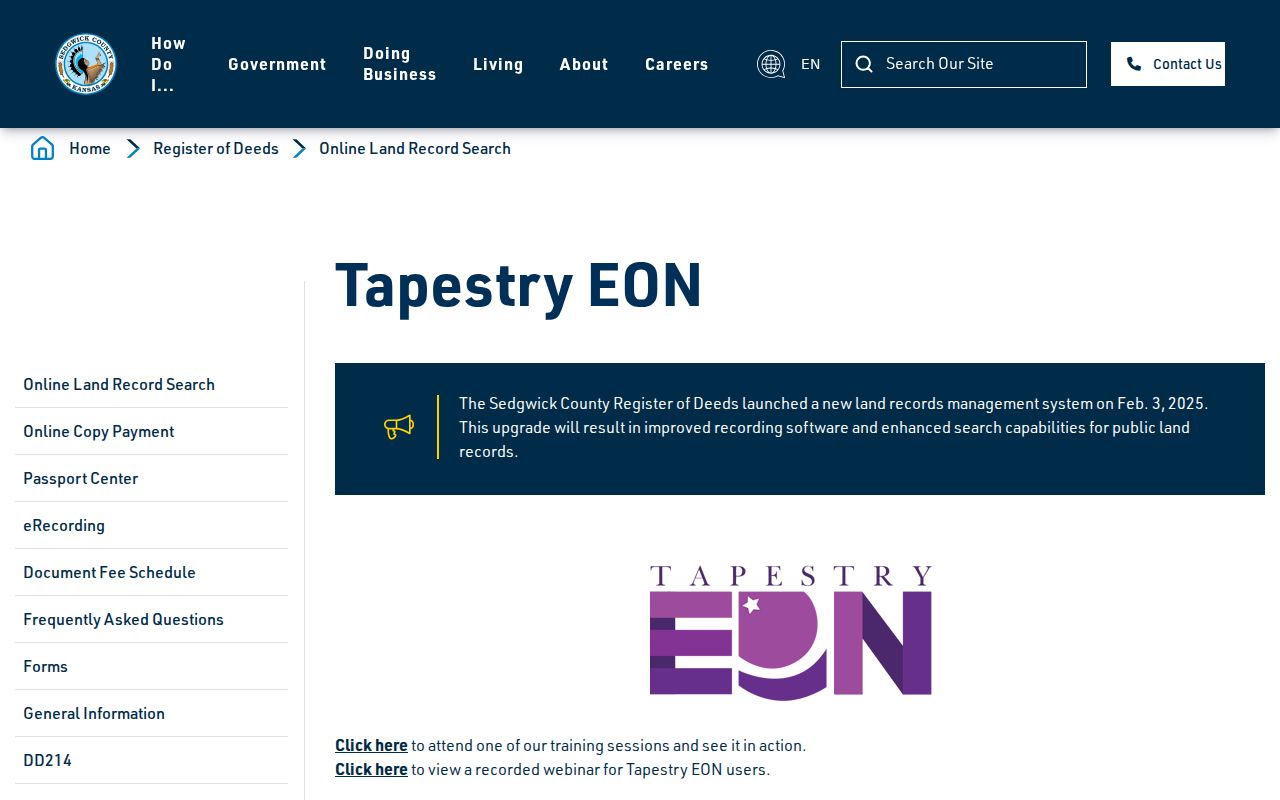
The Sedgwick Register of Deeds page displays a grantor-grantee and legal-description search, a layout a reader can expect to recognize in other Kansas counties' vendor systems.
Ness County Kansas Deed Records Cutoffs
Ness County shows why "online coverage" takes more than one date. Its Register of Deeds describes searchable documents back to 1988. Index images are scanned through 2023. For newer documents, its instructions say to search by legal description. Then choose "Find now." This is a Ness County example; Kansas sets no single statewide cutoff year. The index instructions also note a name search can miss an entry. A spelling error or omission can cause it. A no-hit just means try again. Use another name form, a legal description, or a date range. Then ask the office about the bound index or counter terminal. It is not proof a transfer never occurred. Open the Ness County Register of Deeds instructions to compare the county's current search directions.
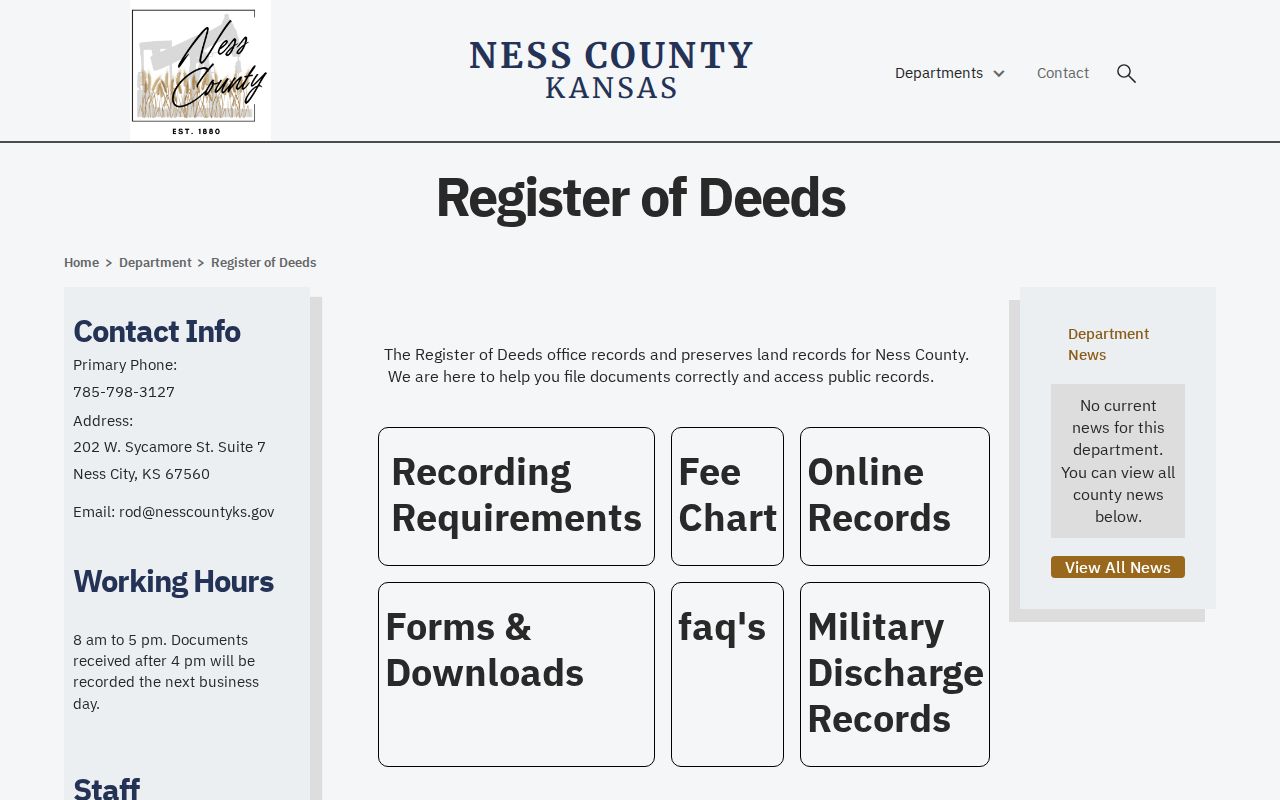
Ness's published notes keep three things distinct: older searchable documents, scanned index pages, and the newer legal-description route, rather than presenting them as one continuous online set.
| Ness search field | How it is used | Coverage note |
|---|---|---|
| Party name | Try one name part, in either name order; exact-name mode is optional. | Spelling and indexing can vary. |
| Recorded date | Enter a from/to range, or repeat a date for one day. | No dates search the county's stated modern range. |
| Legal description or subdivision | Search a subdivision or section, township, and range; use the folder control for scanned index images. | Useful when a street address or parcel key fails. |
| Block and lot | Enter the platted block or lot value. | County instructions allow letters or numbers. |
| Section, township, range | Enter the rural land-description parts. | Use for unplatted property. |
| Book/page prefix | Older books may use a series prefix before the page reference. | Prefix meanings vary by book series. |
| Township and range | Enter each numeric part of an unplatted land description. | Use the county's own required format. |
| Search / Find now / file folder | Controls change the search or open scanned index pages. | Result behavior depends on the selected mode. |
Ness County's published remote terms run $25 for a day or $250 for a month. A 4.5 percent card fee and $0.50 per page are added on top. Longer plans cost $500 for six months or $900 for a year. The per-page charge still applies to those plans. Those are Ness prices, not a Kansas schedule, and they can change. For any other county, call or email the Register of Deeds first. Do not pay for a plan that may not reach the years or image type needed.
Trace Kansas Deed Records by Party
Most Kansas recorder searches follow the parties, not a modern street address. The grantor conveys an interest; the grantee receives it. A chain of title is the ordered sequence of recorded transfers for a parcel. County portals may add legal-description, subdivision, date, or book and page fields. What search modes exist is a local matter. Start from a known deed or the current tax-roll owner. At each step, confirm the legal description matches the same land. A later transfer can carry an estate, trust, company, or fiduciary name rather than the name on the older instrument.
- Find the latest deed in which the known owner appears as grantee, and copy its recording date, document reference, and legal description.
- Read the grantor on that deed, then search the same name as a grantee in the prior period.
- Compare each legal description and deed type before treating two entries as the same parcel.
- When the online index stops, ask the Register of Deeds for older grantor-grantee books or indexes.
- Grantor
- The party who conveys the interest named in a deed.
- Grantee
- The party who receives the stated interest.
- Chain of title
- The linked sequence of recorded instruments for the described land.
- Book/page or instrument number
- The county's reference for locating a recorded document; format depends on the county system and period.
Expect name variety. A party may be listed as “Last First.” You may see initials, stray punctuation, a trust name, or a business suffix. Widen the name form before giving up. Confirm any match against the legal description rather than appearance alone. Similar-looking names are not proof of the same person.
Search grantee-to-grantor to trace a transfer backward. Run the reverse direction to see what that same party later conveyed. Log the instrument number or book and page, along with the filing date and any consideration shown. Record every change in the legal description. A one-name chain may seem to break. Look then for a correction deed, trustee transfer, estate deed, sheriff's deed, or replat. Any of these can explain the gap.
Older Kansas Deed Records in Archives
Older deed research usually starts at the county Register of Deeds counter. That office keeps original deed books, grantor-grantee indexes, plat books, survey records, and microfilm. The Kansas Historical Society holds selected county series in its State Archives. Its Crawford County collection holds deed records from 1867 through 1935 on 26 microfilm rolls. The rolls are arranged by date. They are indexed by grantee, grantor, or number.
Entries in that series can carry instrument type, indenture date, parties, property description, consideration, and filing date. The Crawford collection is a finding aid for one county, though. It does not promise the same years or indexes exist everywhere in Kansas. Identify a specific series in the archive catalog. Then ask the county office which local books or microfilm continue the chain.
The Society's map holdings add original land-survey maps, field notes, federal survey microfilm, and county atlases. These materials can tie an old legal description to a section or subdivision name. When a county series has been filmed, the archive research room and interlibrary loan are both options. Availability varies, so give staff the county, record type, years, and legal description. The Kansas Historical Society's Crawford County deed-record finding aid describes the filmed series. It also explains the index arrangement.
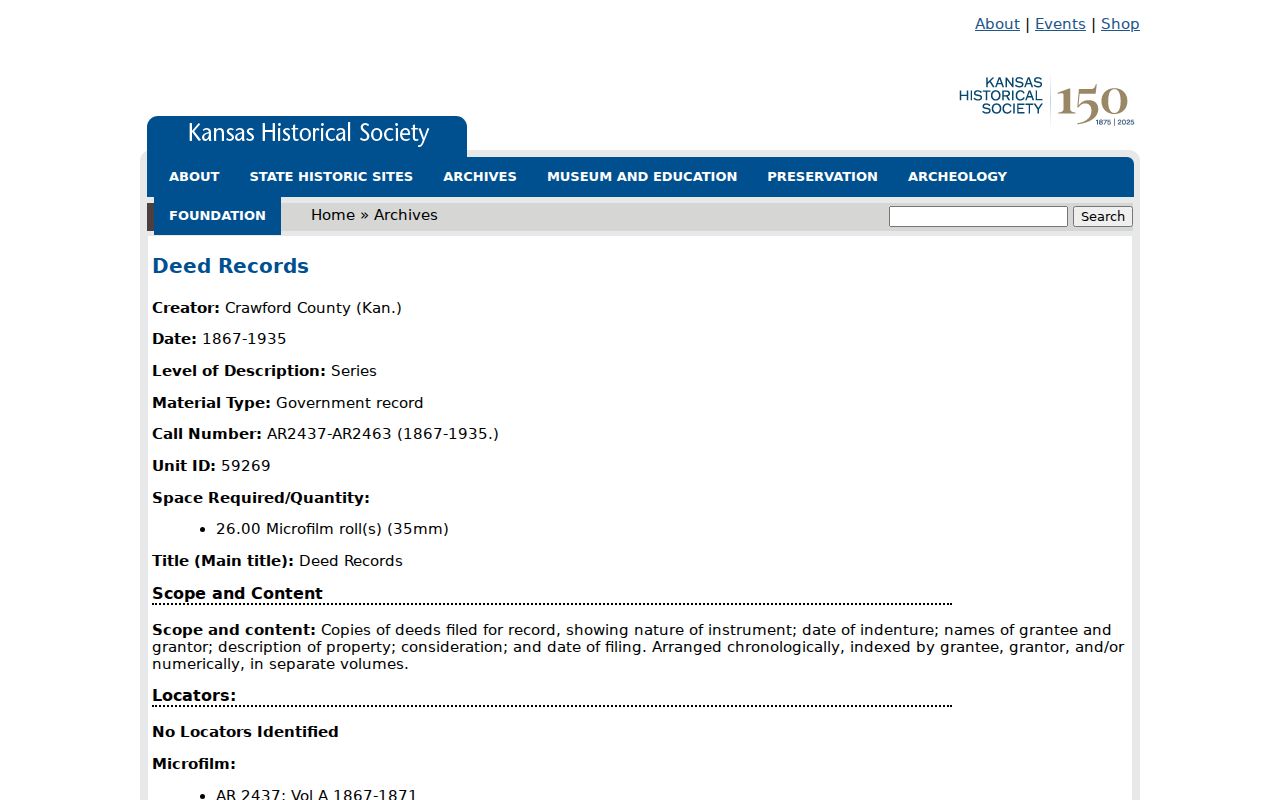
A historic series like this shows the party, description, and consideration fields that older deed records preserve. That detail matters when a modern property search cannot reach far enough back.
Kansas Deed Index Prefixes and Name Gaps
Ness County's older book references carry prefixes such as D, MS, PT, OG, OGR, and RA. Its guidance notes that later books may drop the prefix entirely. Those codes belong to Ness, not to a statewide format. Ask the county clerk what a prefix means before citing it in a copy request.
Scans and indexes behave oddly in places. A scanned page may be visible while the index stays hard to search. A document may sit under a different party style. Sedgwick's Tapestry guidance urges "less is more," one criterion at a time. Ness warns that names can be misspelled or omitted. Simple queries first, then a second name form, legal description, and date range, will outperform a complicated one.
The free Kansas Register of Deeds Association contact directory lists every local custodian by phone or email. Ask about index cutoffs, counter terminals, copy options, and whether historic books can be viewed at the office.
When an online name search stops short, skip the unverified commercial indexes. Request the older grantor and grantee volumes from counter staff instead. Then check the Kansas Historical Society catalog or a local library for a microfilm run. A written KORA request can seek a specific deed or index image. But the custodian need not assemble a chain-of-title report from several books.
Property Fraud Alerts in Kansas Deed Records
Several Kansas counties now offer alerts. The alerts fire when a chosen name appears on a newly recorded instrument. Sedgwick County's free Property Fraud Alert reports a document number, instrument type, and recording date. It also reports the matched party name. A match is only a prompt. It is not a finding of fraud and not a title lock.
Reno County launched its Fraud Notify service in March 2025. It likewise calls the service an early warning that does not prevent fraud. Every service is county-specific. An alert subscribed in one county does not monitor land records across Kansas. Check the appropriate Register of Deeds site. Compare the alert against the recorded instrument itself.
Sedgwick's service takes name-match subscriptions and can deliver alerts by email, text, or voice. The returned document number, type, date, and party name help a subscriber. Together they locate the official entry in the deed records. Trust names may appear in more than one style. An alert under a variant is still just a signal to verify, never a legal finding. See the Sedgwick County Property Fraud Alert page for that county's signup and alert details.
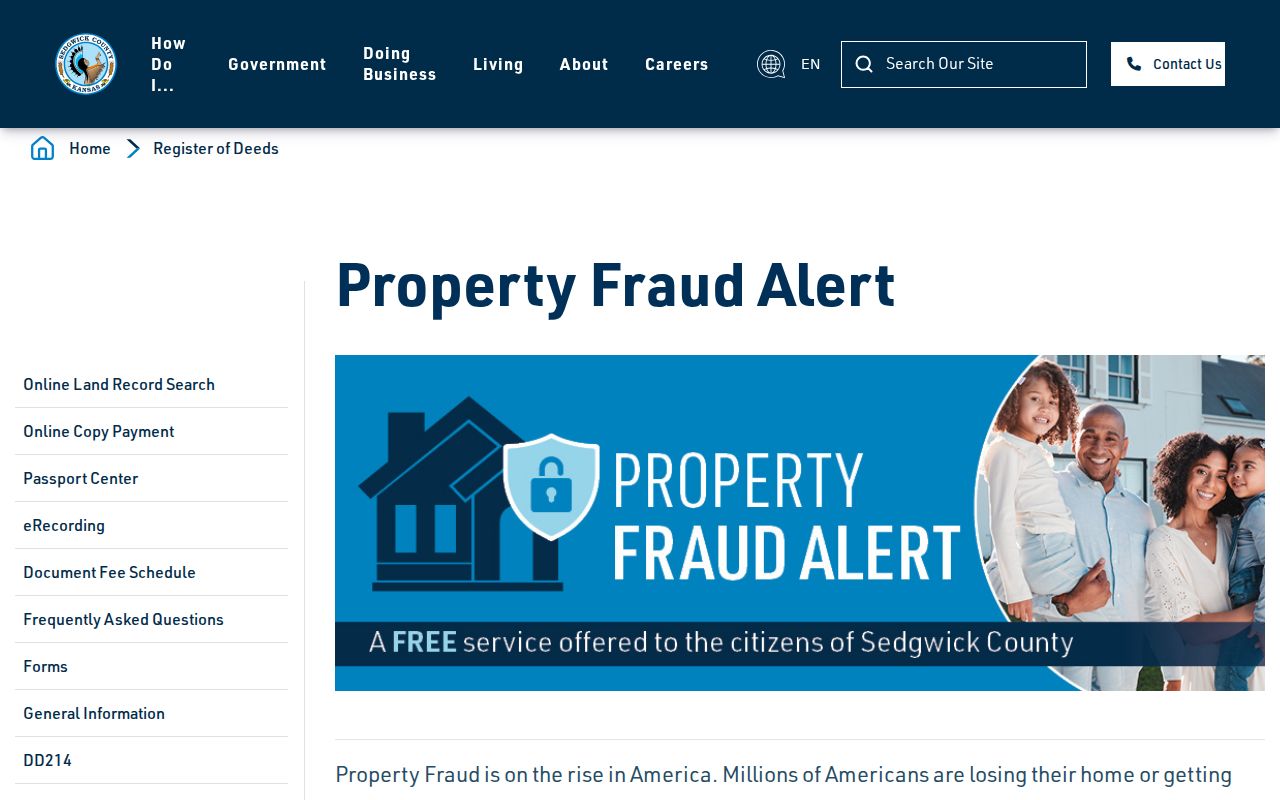
Those alert fields exist so a subscriber can pull the source filing. The recorded instrument, not the alert, holds the party names, legal description, and recording reference worth checking.
Get a Copy of Kansas Deed Records
Found your recording reference? The next step is turning that index entry into an actual copy. Start with the county portal's image option if one exists. Otherwise, contact the Register of Deeds for a counter or copy request. Before anything else, ask about the format. Plain or certified? Is there an image charge? Will the office take a written request by email or mail? Kansas sets no single statewide deed-copy fee. County rules on payment methods and remote access differ from place to place.
Sometimes the portal simply does not show the document. In that case, request the existing deed by grantor, grantee, legal description, and date. You can also cite the book/page or instrument number. A focused request like this helps the custodian find the file fast. The Kansas Open Records Act allows an agency to charge reasonable actual costs. It may also require payment in advance. It does not have to build a new report or take on open-ended research for you.
KORA requests go in writing to the actual county custodian. The agency must respond as soon as possible. That deadline is no later than the end of the third business day after receiving the request, or it must explain the delay. A denial must state its legal basis when required. Say clearly what you want: an electronic scan, in-person inspection, a paper copy, or a certified copy. Ask for a fee estimate before work begins.
Web access is not the only route. A call or email to the Register of Deeds can confirm the right office. It can also confirm the index cutoff, copy formats, and payment methods. A visit during local counter hours works too. Hours and fees are not standardized across Kansas counties. A clerk can point you toward older books. KSHS or a library may hold selected film or finding aids. For request and fee rules, the Kansas Attorney General's KORA FAQ is the place to start. Then contact the county office listed by the ROD directory about its own deed-copy process.
| Access route | What to ask for | What varies locally |
|---|---|---|
| County portal | Index hit, linked image, or print option. | Coverage, account terms, and image price. |
| Counter or public terminal | Older index books, deed volume, or an in-person copy. | Hours, terminal access, certification, and payment. |
| Phone or email | Confirm cutoff year, reference format, and copy instructions. | Staff assistance and accepted request format. |
| Written KORA request | An existing instrument identified by parties, parcel description, or document reference. | Actual-cost estimate and delivery format. |
| Archive or library | Finding aid, microfilm, or a historic plat/book series. | Holdings, research-room hours, and interlibrary loan. |
Recorded does not mean title cleared. A Kansas deed index shows what the county recorded. It does not rule out unrecorded interests, indexing errors, or later filings; a title conclusion requires review of the instruments and appropriate professional work.